

Why This Spring Is Worth Paying Attention To
The start of the 2026 season has quietly become one of the more interesting setups we’ve seen in a while. Used sales in California stepped up meaningfully from March, inventory slipped under 2,000 listings for the first time this year, and inquiry volume at 50 North has climbed consistently month over month since last fall, with year-over-year activity running significantly ahead. Put simply, buyers are engaged, sellers are watching closely, and the market has a little more energy behind it than the national headlines would suggest.
What You’ll Find Below
- What sold this month and where the activity was strongest
- How California inventory is shifting, and what the pockets of tightness mean for you
- Current boat loan rates, broken out by loan size
- A straightforward update on fuel prices and what’s moving them
- The national new-boat picture and why the yacht segment stands out
- What we’re seeing on our phones, in our offices, and online
California Sales, March 15 to April 15
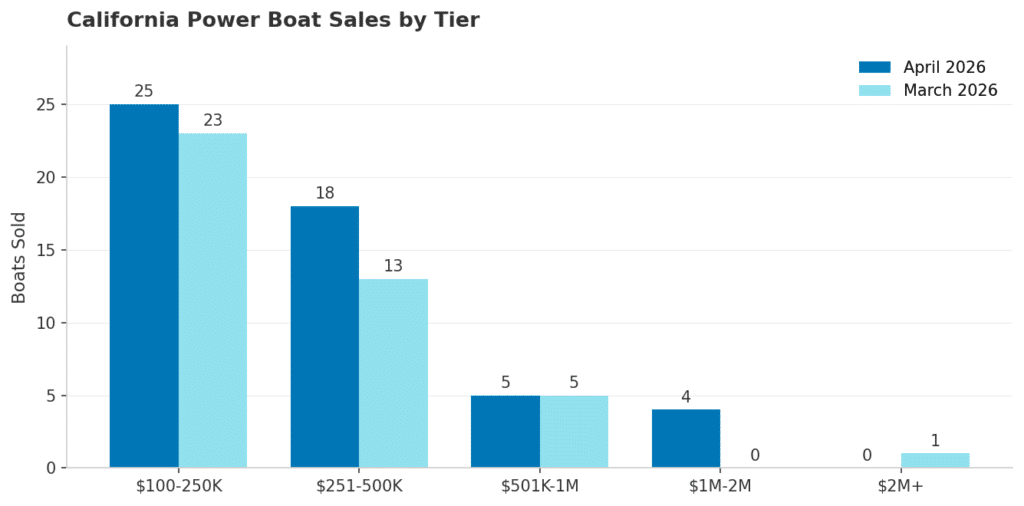
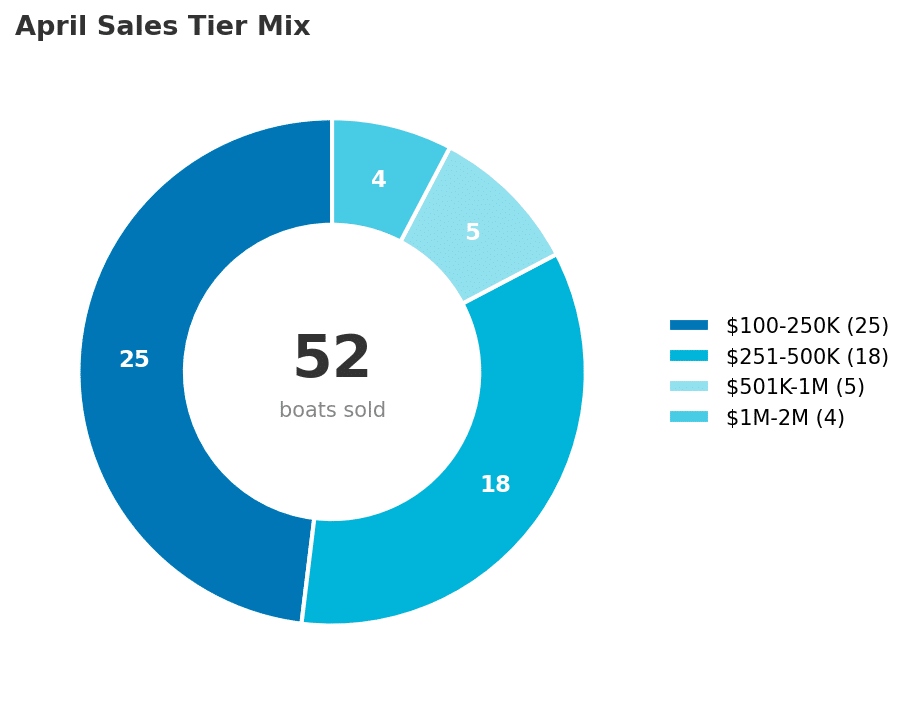
The $251K to $500K range was the busiest slice of the market this month with 18 transactions, and sales in the $1M to $2M range picked up after a quiet March. The above-$2M category didn’t post a transaction in our window, which happens periodically at that end of the market because those deals run on their own timelines. Nothing to read into there.
California Inventory, Mid-April
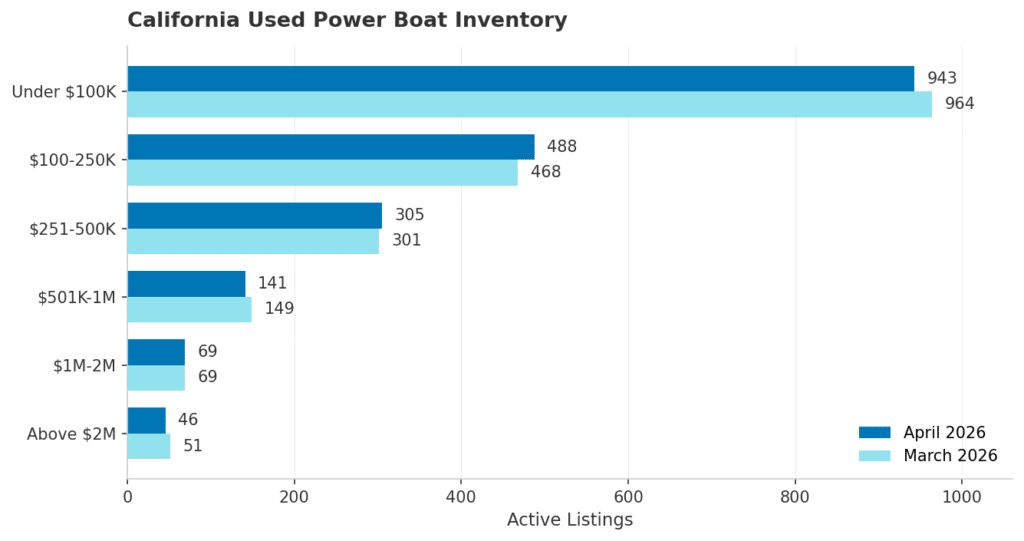
Total California listings dipped below 2,000 for the first time this calendar year. The activity underneath that headline matters more than the number itself. Boats under $100K are moving quickly and the $100K to $250K range has grown as owners step up into their next boat. The more meaningful tightening is happening in the $501K to $1M range and at the top of the market, where well-prepared listings are genuinely harder to find than they were 30 days ago. If you’re a serious buyer in those ranges, it’s worth moving when the right boat appears.
Financing
Marine lending has been steady through April. Based on current quotes we’re seeing from our lender partners, here’s what well-qualified buyers are looking at today, fixed rate, up to 240-month terms:
- $50K to $149K loan: 6.24% to 7.74%
- $150K to $2M loan: 5.99% to 6.74%
- Above $2M: generally priced individually
The Federal Reserve held its target range at 3.50% to 3.75% at its March 18 meeting, the second meeting in a row without a change, and continues to signal one rate cut later this year. For anyone in the middle of a deal, the message is simple: quotes have been predictable, and lenders are closing on time.
Fuel Prices and What’s Behind Them
Fuel is the part of the macro picture that actually touches boat ownership. After a sharp run-up in March tied to Middle East tensions, prices have eased somewhat over the last couple of weeks. According to the U.S. Energy Information Administration (EIA, the federal agency that tracks national energy data), the April 21 weekly release shows the national regular average around $4.04 per gallon, and AAA has California’s statewide average at $5.88 today. Both are down from recent peaks but still above where we started the year.
Worth remembering: those are street prices for cars. Fuel at the dock runs meaningfully higher. Marina fuel carries additional transport costs, storage, and overhead on top of the base price, so whatever you’re paying to fill your truck, expect to pay noticeably more to fill your boat. The directional story is still useful though, when street prices move, dock prices generally move with them, just at a higher baseline.
On the crude oil side, West Texas Intermediate (WTI, the U.S. benchmark price for a barrel of crude) has been trading near $89 per barrel this week as the Strait of Hormuz situation continues to swing headlines back and forth. That volatility is worth knowing about, not worth reshaping a buying decision around. We’ve had a few conversations at 50 North with clients who have asked about fuel costs, and the honest answer we give is the same one I’d give a friend: it’s a real line item, but it’s not the line item that decides whether boat ownership makes sense for you.
The National New-Boat Picture
The National Marine Manufacturers Association (NMMA, the industry’s primary trade group) publishes the broadest data on new powerboat sales in the U.S. The NMMA’s 2025 wrap-up showed total new powerboat sales at 215,237 units, down 8.8% from 2024. Almost every segment softened.
The exception was yachts, which finished 2025 up 1.8% and was the only category to post growth for the year.
That’s a telling data point. When economic conditions get choppier, the buyers who keep transacting tend to be the experienced ones who know what they want and why. It’s a pattern we see in the brokerage world too. The market gets more selective rather than weaker, and the deals that close tend to be the best-prepared boats meeting the most committed buyers.
What We’re Hearing and Seeing
Our own activity has been trending in the right direction for several months now. Website traffic is up, phone calls are busier, and walk-in activity at our offices has picked up noticeably as the weather has turned. Year over year, our inquiry volume is significantly ahead of where we were a year ago. The conversations have also shifted in quality. More buyers are coming in with specific boats in mind, specific timelines, and real questions about surveys, sea trials, and financing. That’s typically what precedes a stronger run of transactions.
Usual caveat: this is our view from our desks, not a statement about every corner of the California market. But we track these signals carefully because in past seasons they’ve shown up in closed-deal data a month or two later.
Boating’s Place in the Bigger Economy
Worth a quick mention. The U.S. Bureau of Economic Analysis (BEA, the government agency that measures the national economy) recently reported that outdoor recreation contributed $696.7 billion to U.S. GDP in 2024, about 2.4% of the national total. Within that, boating and fishing was the single largest activity category, at $38.4 billion.
That figure isn’t a buying signal and I’m not using it as one. But it is a reminder that what we do here is a durable, multigenerational part of American life rather than a niche that rises and falls with every economic cycle. Markets like the one we’re in now, selective but active, tend to reward the people on both sides who approach them with preparation and patience.
Looking Ahead
Weather is cooperating. Financing is stable. Inventory is tightening in the segments where good boats disappear quickly. The buyers who have been watching all winter are starting to move, and the sellers who present cleanly and price realistically are getting real attention. This is the part of the year where preparation pays off on both sides of the transaction.
As always, if there’s a topic you’d like me to cover in a future report, send it my way. The best ones usually come from the questions you’re already asking.
Mark Gibbons
President and Owner, 50 North Yachts
All sales data represent California used power boat transactions, reported on a rolling 15th-to-15th basis. Inventory data reflects active listings at the time of reporting. Financing rates quoted as OAC; actual rates subject to credit profile, vessel age, and lender terms.